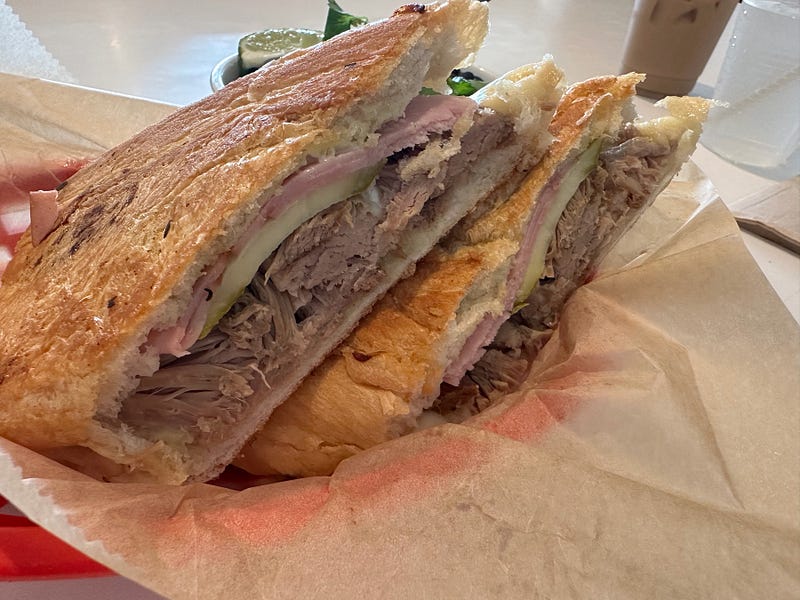
In Ybor’s cigar houses, a humble lunch stitched workers together — and later, a city’s identity.
The air inside Ybor’s cigar factories in the late 1800s and early 1900s was heavy with the earthy scent of tobacco. Heat and salt clung to the walls as torcedores — cigar rollers — settled at narrow wooden tables, hands moving in practiced rhythm over leaves shipped by boat from Cuba. These buildings had been purposely turned to the light before the age of electricity; long walls faced east and west so the day could pour in and carry the work along.

To ease the hours, the workers elected an el lector, a reader paid from pooled wages. He read novels and newspapers — local dispatches, international headlines, horoscopes — and sometimes he acted out a scene to stir the room. When the voice paused, everyone knew what came next: the shift from listening to chatter, the scrape of chairs, the comfort of lunch…

Workers often brought food to share among friends, but one sandwich began to stand out on the factory floor — wrapped in paper, tucked into a pocket or purse, pressed flat for the hand.
No one remembers exactly who made it first. Some said it came from Havana, others from Key West, but by the time it reached Ybor, it already had a name — el Cubano. A workingman’s lunch that fit the rhythm of a new city.
As new neighbors joined the lines — Italians, Spaniards, Germans — the Cubano shifted to meet them. The Italians brought salami, a familiar comfort that changed the balance of the sandwich for good. The Spanish insisted on garlicky roast pork, mustard for bite. Local bakeries — La Joven Francesca at first, then La Segunda Central — sent out long loaves of crackling Cuban bread, a palmetto leaf laid along the top before baking.

At the tables, the sandwich gathered meaning. Cuban, Spanish, Italian, and German workers sat shoulder to shoulder, unwrapping the same lunch, trading pieces the way they traded stories. The lector might be reading from El Diario de la Marina, or turning a page of Victor Hugo’s Les Misérables. Then, when he paused, tobacco and coffee would mingle with the warmth of pressed bread, and the room would settle into that comfortable hush a good meal brings.
Floridians guard their Cubans as closely as New Yorkers guard their pizza, and regional loyalties run deep. Ask around and you’ll hear about which version is best and most authentic — but each version reaches back onto the cigar factory floor.

Tampa style includes salami, an Italian addition: ham, roast pork, salami, Swiss, mustard, and pickles on Cuban bread, pressed. (and never any tomato or lettuce…)
Miami style leaves out the salami but leans into the press: ham, roast pork, Swiss, mustard, and pickles, pressed thin until the crust sings.
Key West style remembers the early days: pork-forward, sometimes with a slick of mayo or a buttered, toasted loaf — details shifting with the baker and the block. This version may include tomato and lettuce.
Today, the arguments are half the fun – Tampa or Miami? Salami or no? In those Ybor factories, and eventually in all of the Florida Cigar Factories of old, a humble lunch became a signature. Portable, cheap, and shared, it bound immigrant workers and helped brand cities. From rolling tables to lunch counters to festival stages, the Cuban sandwich still carries a century of Florida between two sheets of pressed bread.